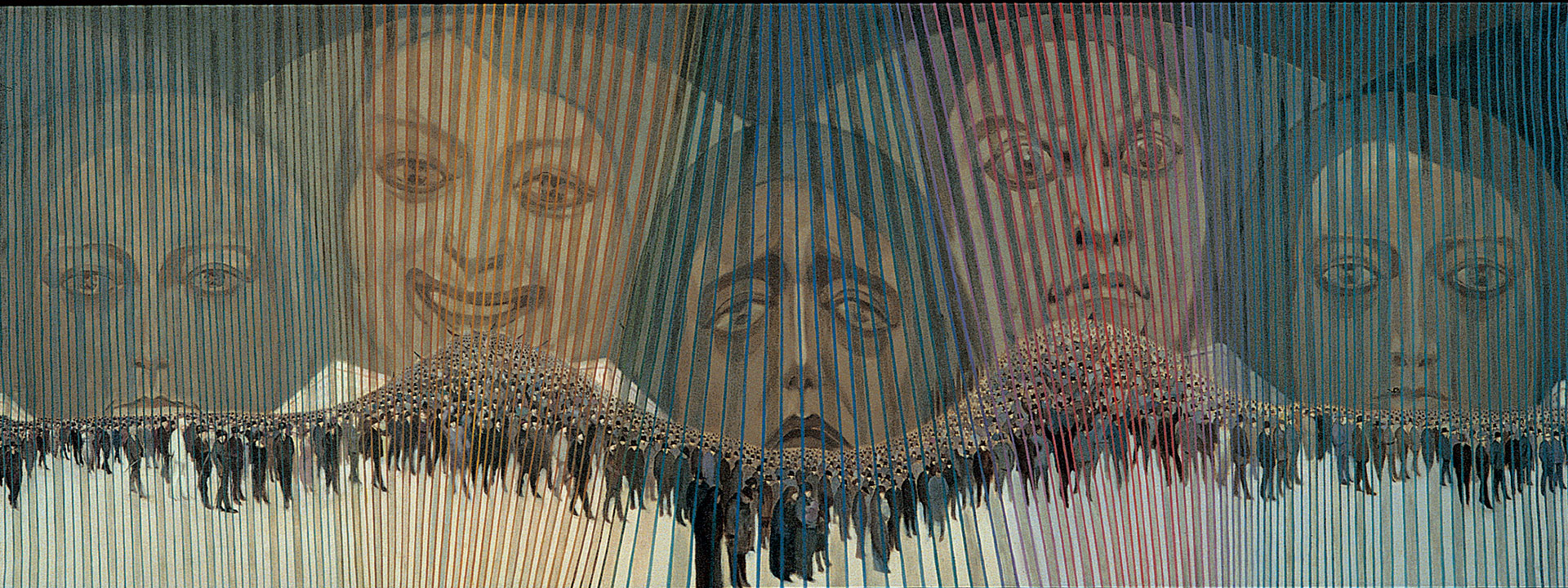
Wolfsoniana is the place where the selected objects of the Wolfson collection find their expositive place. The visitor who walks throuh furnitures, paintings and furnishings taht aere exposed, feels the taste of time and the importance of themes that Micky Wolfson wants to emphasize through his collection.
The arrangement of Wolfsoniana follows a chronological/thematical address. Beside the chronology of the cultural movements, of the artistic currents and stiles, they wanted to emphatize the thematics which characterize the collection:
- evolution of decorative arts,
- art of propaganda,
- work
- travel,
- international exhibits and expositions.
At woflsoniana the visitor feels and tastes the spirit of the collection in his complexity and heterogeneity.
Exoticism
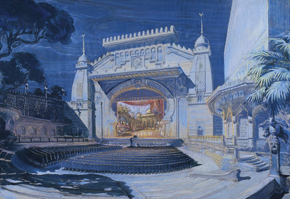
The so called Moorish style became popular in Italy in the second half of the Nineteenth Century thanks to the great exhibitions and it spread mainly in places dedicated to entertainment and amusement: grand hotels, bathing establishments, thermal baths, summer arenas. In the abodes of the new rising middle class, the cabinet-makers, besides undertaking the realization of neo Renaissance and neo Baroque rooms, expressed their purchasers’ taste for exoticism at least in the smoking rooms, or in the bedrooms. This is the case of the monumental room in neo Egyptian style created in 1890 by the two oriental style Bolognese painters, Fabio and Alberto Fabbi, for the Palazzo Gonzaga in Guastalla near Mantua. Re-interpreting certain Islamic art motives, the Milanese furniture-maker Carlo Bugatti elaborated, by means of formal research, a new style, the originality of which was immediately recognized at international level. back
Art Nouveau
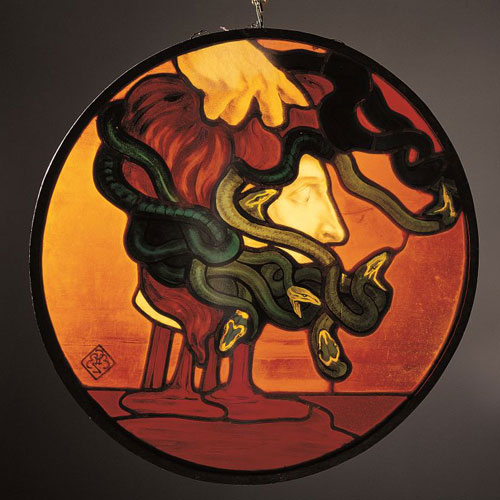
The second section of the museum is dedicated to Art Nouveau. A decorative style widespread throughout Europe and the United States between 1890 and the First World War, it presents characteristic peculiarities according to the nations where it developed. In this sense the Wolfsoniana offers an example of Italian Liberty by means of the partial reconstruction of a living room realized by the company Luigi Fontana & C in 1902. In this case the sinuous lines show the close relationship with the Art Nouveau of the Franco-Belgian. The Italian examples are flanked by some international productions with particular attention paid to the Mittleuropa area, as is shown by the inlaid chest of drawers by Leopard Bauer and some office furniture by the Catalan Gaspar Homar. The sideboard by the Austrian Joseph Maria Olbrich and the study by the Hungarian Odon Farago and the Medusa glass door by Vetrate Artistiche G. Beltrami in Milan are works shown at the International Exposition of Modern Decorative Arts in Turin in 1902. back
Roman School
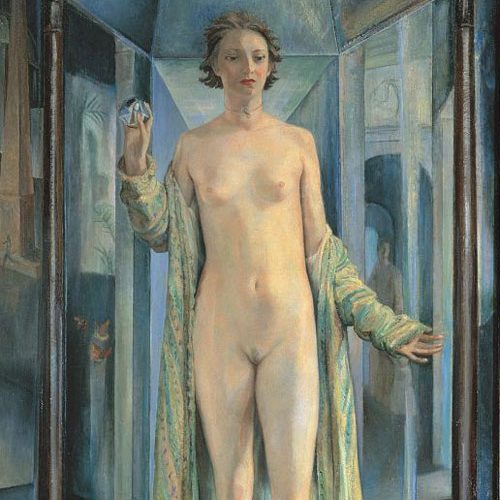
Duilio Cambellotti is one of the most interesting personalities in the Italian decorative arts scene of the first half of the Twentieth Century. Characterized by a “craftsman” approach, with a strong bent for the integration of different artistic modes, the Roman artist was a painter, sculptor, illustrator, engraver, scenographer and costume designer for the theatre and for the cinema. He designed furniture, ceramics, glass doors, medals, jewels and entire rooms. Le curiose and La notte, his elegant and archaic cabinets exhibited at the International Biennial Exhibitions of Decorative Arts in Monza in 1923 and in 1925, La Panca dei Timoni and Il Mobile dei Falchi, the glass door Stemma del Trecento and some ceramics give an idea of the quality and the versatility of his production. Cambellotti helps to contextualize the works of artists who were active in the Roman circle during the Twenties: Vittorio Grassi, Melchiorre Melis, and some young artists who primarily devoted themselves to ceramics. Idolo del prisma (1925) by Ferruccio Ferrazzi is a symbolic reference to the pictorial research of the same period. back
Antonio Rubino
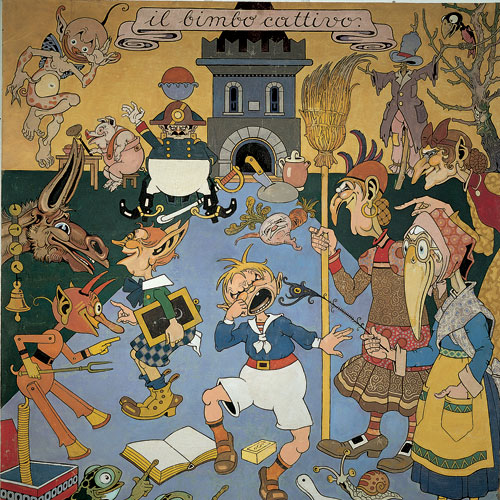
Antonio Rubino (1880-1964), founder of the most famous children’s magazine “Il corriere dei piccoli”, was influenced by the Symbolist circles and by the Art Nouveau, of which he offered a brilliant interpretation in the field of illustrations using later iconographic models, typical of the Art Deco style. He dedicated most of his artistic production to the world of children as is shown in the room designed in 1921 for his companion-in-arms Commendator Giani from Busto Arsizio. The furniture is linear and the decorations appear uniform both in the painted panels and in the furnishings. Among these, two small anthropomorphically shaped chairs stand out. back
Art Deco
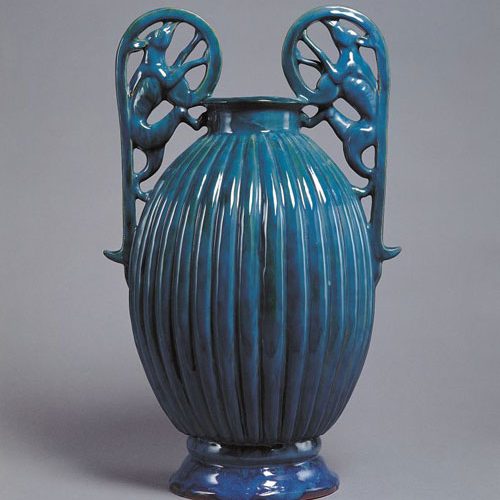
The Wolfson collection – the furniture, the metalwork, Gio Ponti’s and Guido Andlovitz’s ceramics and the vase by La Salamandra of Perugia exhibited in Monza in 1930 – testifies the spread of the Art Deco style in Italy which lasted through the first years of the Thirties. In the attempt to renovate Italian art by means of a direct confrontation with international production, the First International Biennial Exhibition of Decorative Arts was established in Monza in 1923. The exhibition is divided into regional sections and presents several displays such as the dining room by Vittorio Zecchin in the Thrre Venetias section and the furniture by Ettore Zaccari in the Lombardy one. Even though they still present features of the local art, they are linked to the European artistic panorama. L’Exposition Internationale des Art décoratifs et Industriels modernes in Paris in 1925 banished Rustic Art and decreed the triumph of Art Deco, the name actually originating from the Parisian exhibition. back
Novecento
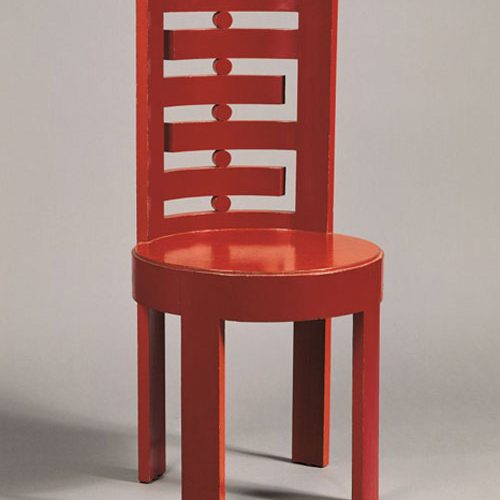
Twentieth Century Art, or rather “Novecento” style, is particularly rich and versatile from an expressive point of view, if it is analyzed within Italian cultural events of the period straddling the two world wars. As from 1922, the year in which Margherita Sarfatti’s artistic movement made its first public manifestation, this style spread and made a name for itself within the field of architecture and the figurative and decorative arts. The several linguistic variants of this tendency though shared a common denominator, in other words a return to a classic ideal. Despite the different declinations and the adherence to an international climate of a return to order, the Twentieth Century style nonetheless maintained the cultural inheritance of the avant-gardes, also by absorbing the stimuli of the most innovative research approaches, in a sort of formal balance which can for example be found in the chairs designed by Marcello Piacentini (1881 – 1960) as a wedding gift for Fiammetta, Margherita Sarfatti’s daughter, and in the Portrait of the Art Critic Matteo Marangoni painted by Baccio Maria Bacci in 1919. back

Rationalism
The Palazzo degli Uffici Gualino (1928) in Turin is one of the first examples of Rationalist architecture, planned by Giuseppe Pagano and Gino Levi Montalcini. Of the furniture pieces drawn by the two architects only the small arm-chair in buxus remains. It was exhibited at the IV Monza Exhibition in 1930, a show where architecture has a space of its own next to the decorative and industrial arts. While the two tendencies, “novecento” and Rationalism continued to confront each other in Monza, with the transfer to Milan in 1933 during the V Triennial, Rationalism prevailed in the several pavilions built in the park surrounding the Palazzo dell’Arte by Giovanni Muzio. In the steel framed building planned by the Ligurian architects, Luigi Vietti introduced his armchair in lamellar bent wood, while during the VI Triennial at the Exhibition on Homes Gabriele Mucchi exhibited his tubular metal armchairs; the same armchairs that Luigi Carlo Daneri used to furnish the Piaggio Children’s Holiday Camp in Santo Stefano d’Aveto. back
Futurism and Propaganda
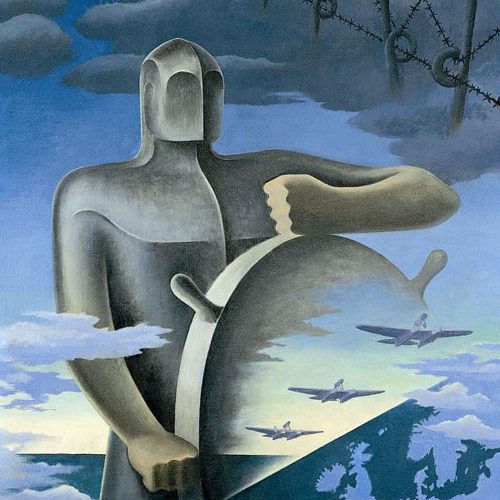
The main fascist iconographic motives interweave with the development of futurist research in the years straddling the two wars and in particular with the Thirties Manifesto of Aeropainting. While the fascist political strategy used classical models in order to emphasize its similarities regime with the Roman Empire, the works of the artists who belonged to the various branches of the movement called Second Futurism still headed by Filippo Tommaso Marinetti reflect the celebratory themes of an official art inspired by war-mongering inclinations and a widespread cult of the Duce’s figure and personality. The painting by Ettore Thayaht, Il grande nocchiere (The Great Helmsman) 1939, which depicts Mussolini as a great robot, is a revealing example of this tendency. back
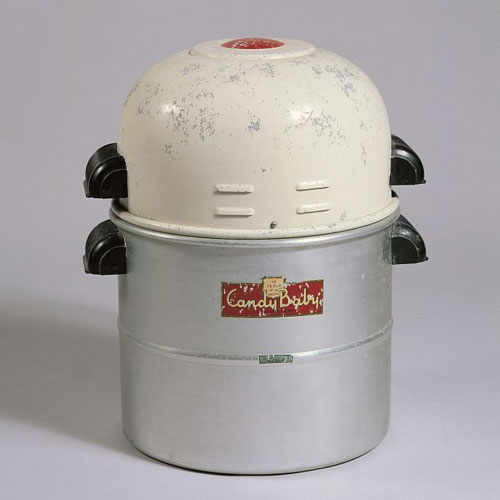
Towards industrial design
In the transportation sector, the transition from mechanised craft production to industrial fabrication, which was not fully completed in Italy until after World War II, is represented in the Wolfsoniana through a group of objects which explore the evolution of transportation in the first half of the twentieth century: the bicycle with its wooden rims by the Giuseppe Bianchi company of Florence, the present-day Betamotor; the turbo-liner Conte di Savoia and the Littorina Fiat represent Fascist Italy anxious to affirm its primacy in every field; and, the Vespa 125 made by Piaggio in 1949, is the unequivocal emblem of the Italian post-war economic miracle. back