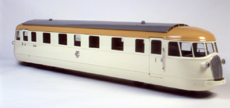
In the transportation sector, the transition from mechanised craft production to industrial fabrication, which was not fully completed in Italy until after World War II, is represented in the Wolfsoniana through a group of objects which explore the evolution of transportation in the first half of the twentieth century: the bicycle with its wooden rims by the Giuseppe Bianchi company of Florence, the present-day Betamotor; the turbo-liner Conte di Savoia and the Littorina Fiat represent Fascist Italy anxious to affirm its primacy in every field; and, the Vespa 125 made by Piaggio in 1949, is the unequivocal emblem of the Italian post-war economic miracle.