Mimmo Rotella 1945 – 2005
24 Apr 2026 — 13 Sep 2026, h 11:00
Palazzo Ducale, Sottoporticato
Twenty years after his passing, a major retrospective dedicated to the master of décollage retraces sixty years of artistic research, restoring the innovative power of a language that defined twentieth-century art.
Featuring over 100 works from museums, foundations, and public and private collections, the exhibition offers a broad and nuanced interpretation of Rotella’s incessant artistic journey from 1945 to 2005. Alongside some of his most celebrated works from the 1960s, the show highlights the extraordinary variety of techniques and languages developed by Rotella throughout his career.
The exhibition path, organized into seven thematic sections, guides the visitor through the key phases of his production: it opens with three early works on paper from 1945 (on loan from the Fondazione Mimmo Rotella) and concludes with Dance Dream (2005), which synthesizes essential themes of his research into cinema, providing a comprehensive vision of sixty years of artistic experimentation. The artist passed away in 2006, and this year marks the twentieth anniversary of his death.
The significance of the exhibition and the rigor of its selection are further evidenced by the presence at Palazzo Ducale of three fundamental works exhibited at the famous 1964 Venice Biennale—the year that saw the triumph of American Pop Art. These include: Tenera è la notte (Tender is the Night) and Violenza segreta (Secret Violence) from 1963, as well as Birra! from 1962.
The Radical Act of the Tear
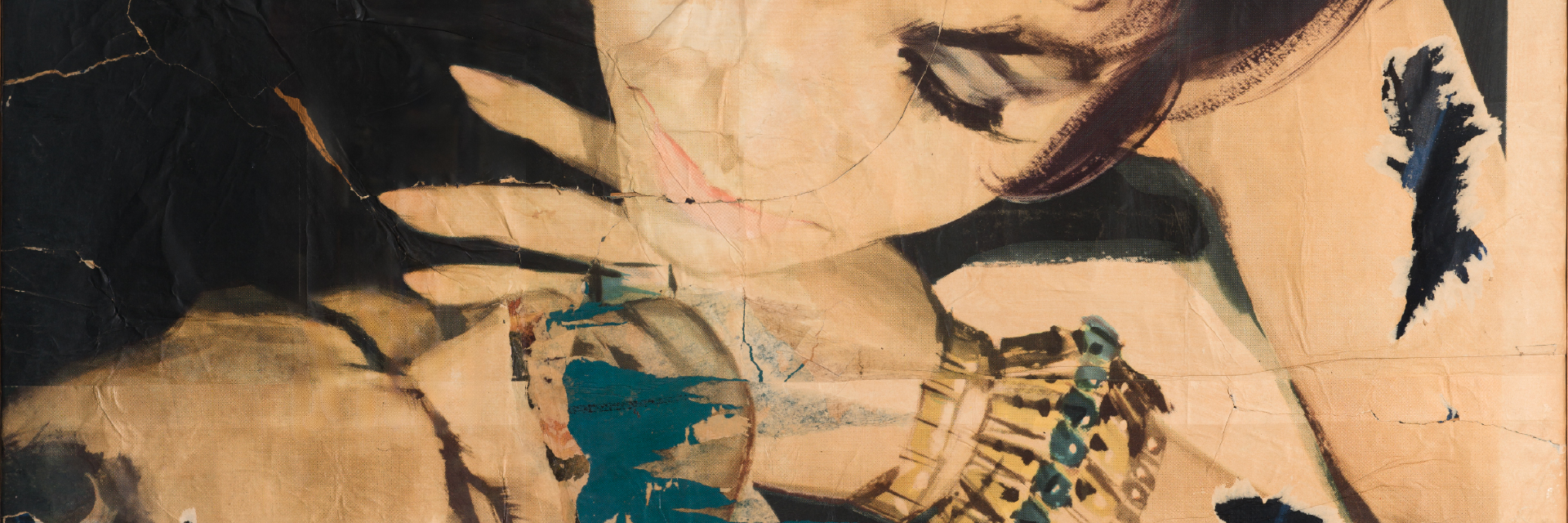
Décollage, in its various forms, remains the common thread of the exhibition. As a radical symbolic gesture of Rotella’s poetics, the “tear” asserts itself as an absolute and disruptive act: a gesture that is simultaneously aesthetic and political, capable of opening new gateways to perception and exposing the hidden truth behind consumerist imagery.
As curator Alberto Fiz states: “It is no longer what lies on the surface that matters, but the fragmentary and fragmented aspect of a real dimension destined to change under the complicit gaze of the observer. The crackling image emerges from its solipsistic dimension to become part of a continuously evolving process.”
This desire to go beyond the surface, investigating matter in its deepest aspects, led the artist in the 1980s toward his sovrapitture (overpaintings). These works engaged in a dialogue with the “return to painting” characterizing European movements like the Transavanguardia, while also confronting Graffiti art—much as he had engaged with Pop Art in the 1960s.
Historical and Contemporary Dialogues
The exhibition also dedicates space to the black-and-white emulsified canvases created during Italy’s “Years of Lead” (Anni di Piombo). During this period, Rotella abandoned the world of celebrities to confront one of the most dramatic moments in Italian history. The result is a sort of personal visual reportage built not on direct reality, but on media-saturated images, filtered and reworked through his artistic language.
His investigations from the 1980s onward are documented by significant works, such as Large Green Blank (1980)—a three-meter piece from the Fondazione Mimmo Rotella in which the artist creates a tabula rasa by covering the image entirely, leaving only the edges free—or Attenti (2004), a three-meter décollage on sheet metal featuring the image of a roaring tiger.
Finally, the show includes a tribute to Genoa, the city where Rotella performed his last Rito della lacerazione (Rite of Tearing) in October 2004. This performance, involving the tearing of posters from walls, took place during the exhibition Arts and Architecture 1900-2000, curated by Germano Celant for Palazzo Ducale. A rare fragment of that happening is presented alongside photographs and a filmed document of the event.
Iconic Works and Unseen Treasures
The exhibition features some of the artist’s most emblematic works, including:
- Naturalistico (1953): A collage on canvas with mirrors and glass.
- Up-tempo (1957): A nearly three-meter retro d’affiche (back of the poster).
- A strappo deciso: An abstract décollage of great expressive power.
- Mitologia in nero e rosso (1962): Exploring contemporary myths of consumer society.
- Il punto e mezzo (1963): Among his first interventions into the world of advertising.
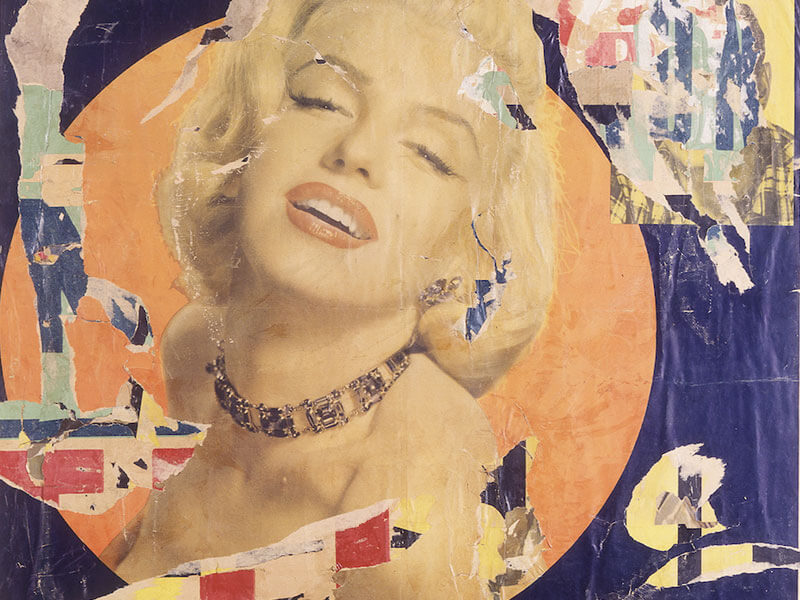
A highlight of the exhibition is Marilyn (1963), one of the most iconic images in Rotella’s oeuvre. Created the year after the star’s death, the work marks the moment Marilyn Monroe became an autonomous, symbolic presence in his art. This décollage is an exceptional loan from the Heidi Horten Collection in Vienna. It is accompanied by a black-and-white photographic transfer from 1963, never before shown in a public exhibition.
A specific focus brings together two 1963 works dedicated to John F. Kennedy: Viva America and Hommage au President. In the latter, Rotella’s reflection on mass society and the trivialization of content is particularly evident, as he juxtaposes Kennedy’s face with an image of an ice cream cone—a visual short circuit that reveals the critical force of his research.
The exhibition is completed by a rich documentary apparatus from the Fondazione Mimmo Rotella, including original photographs, articles, and “epistaltic” poems. Also on display are photographs by Paolo Di Paolo, as well as a series of video contributions.
The exhibition was made possible thanks to major loans from: Fondazione Mimmo Rotella, MART, Sovrintendenza Capitolina, Galleria Nazionale d’Arte Moderna e Contemporanea (Rome), Heidi Horten Collection (Vienna), Collezione Intesa Sanpaolo (Milan), Casa della Memoria (Catanzaro), Archivio Paolo Di Paolo, and Giò Marconi Gallery.
Curated by
The exhibition is produced and organized by Metamorfosi Eventi, in collaboration with the Fondazione Mimmo Rotella and the Palazzo Ducale Fondazione per la Cultura.
Curated by Alberto Fiz
service charter
Consulta la Carta dei Servizi di Palazzo Ducale Fondazione per la Cultura
Leggi